

By Erika Rosenthal, Novastrat Growth | Word count: 1,780 | Reading time: 8 minutes
There is a specific point in medspa and wellness growth where marketing that worked beautifully stops working, and it frequently happens between locations three and four. The first location succeeds because the owner is personally involved in every decision. The second location rides the momentum and reputation of the first. By the third, the cracks are visible but manageable. Past that point, the same playbook that built the business starts actively working against it.
I had this experience when I founded and built my award-winning chain of MedSpas. The fourth spa that I opened failed. I kicked myself because I should have had a system by then. By the third location, cracks were showing and I was spread thin. By the fourth location, the cracks were wide and leaking cash. I waited a long time and focused too much energy into the fourth one, which drained the first three (and me) and created more risk for a very successful business overall. I’ve spent a lot of time since evaluating growth systems and frameworks to help business scale so the same doesn’t happen to others.
This isn't a failure of ambition or capital. The medspa and wellness sector is one of the fastest-growing categories in healthcare-adjacent services, with the global market valued at roughly $24.2 billion in 2025 and projected to climb toward $78.2 billion by 2033 at a compound annual growth rate near 16 percent (Grand View Research, 2026). Private equity has taken notice, with more than $3.1 billion flowing into the sector across roughly 400 transactions over the past five years, much of it aimed at rolling up independent clinics into 10-plus-unit regional chains (Mordor Intelligence, 2026). The capital and the market opportunity are real. What breaks is the marketing infrastructure underneath the growth.
The Pattern: Success at One, Momentum at Two, Cracks at Three
Industry data confirms what most owner-operators discover the hard way. Many clinic owners successfully build a profitable single practice but struggle to scale beyond one location because of operational and marketing limitations that only reveal themselves at scale (Norfolk Daily News, citing industry reporting, 2026).
A detailed case study of a national med spa found the exact symptoms that show up past the third location: inconsistent branding across locations, a lack of local targeting, and a marketing operation that was never built to scale efficiently in the first place (Strategic Voyages Business Consultants, 2024).
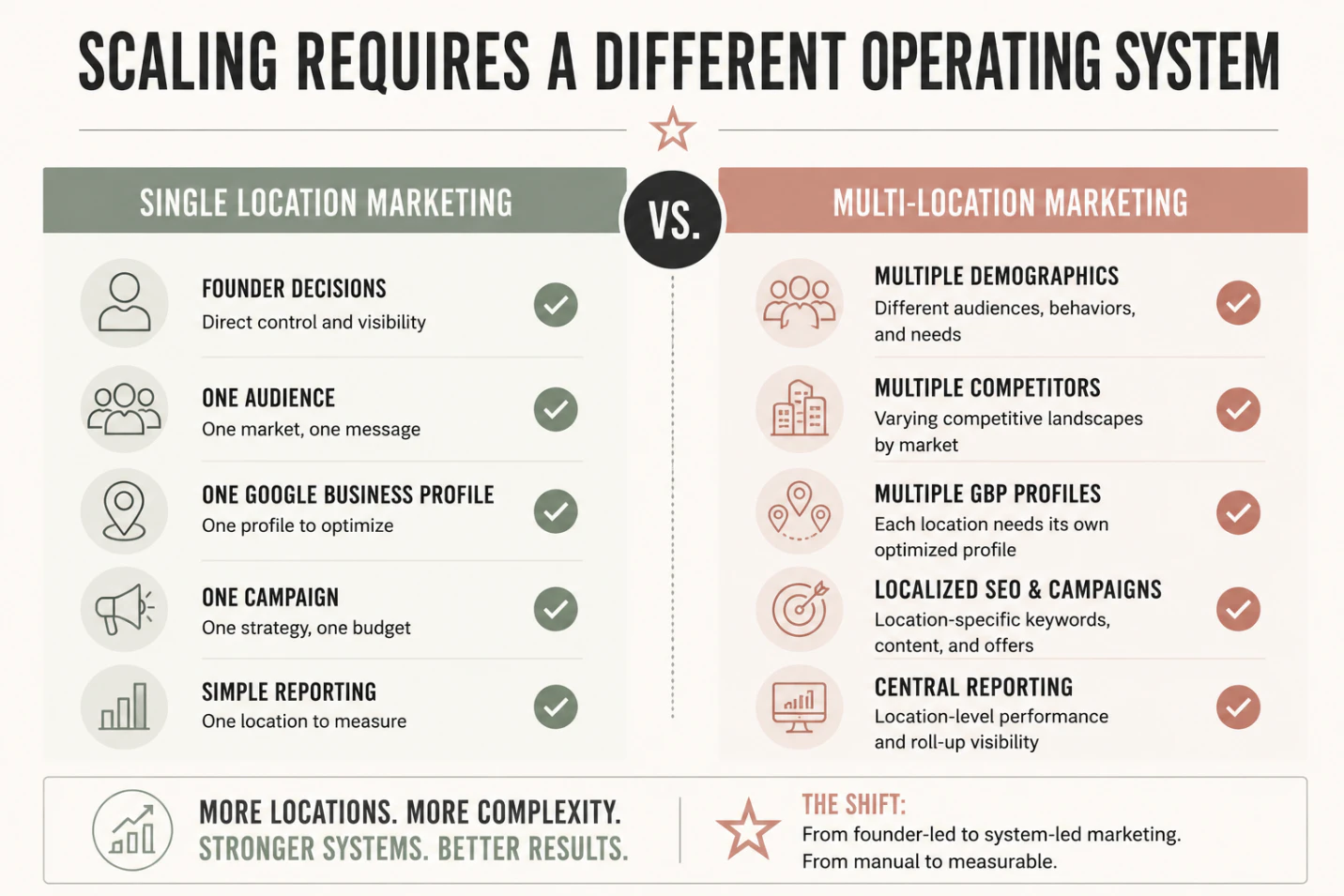
A separate case documented by a med spa marketing agency captured the mechanism precisely. A five-location Florida med spa group had different service mixes, different patient demographics, and different competitive landscapes at each location, yet their previous agency ran a single, identical Google Ads strategy across every location as if they were interchangeable (Chatterbuzz Media, 2026). That is the single-location playbook applied at scale, and it is precisely why it stops working. A campaign built for one market, one demographic, and one competitive set doesn't automatically translate to a second, third, or fourth market. It just gets copy-pasted, and copy-pasted marketing produces diminishing returns location by location.
Why the Third Location Is the Real Breaking Point
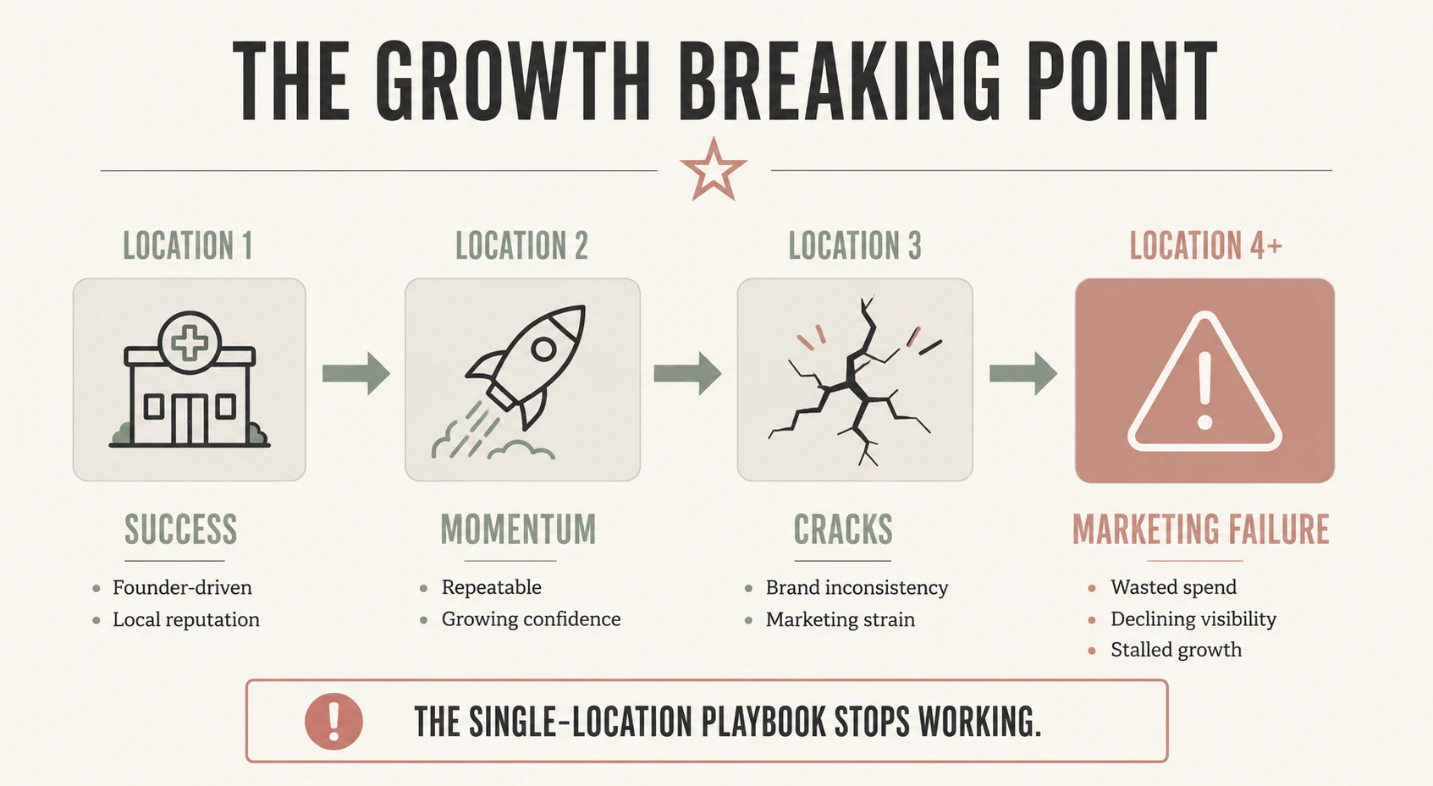
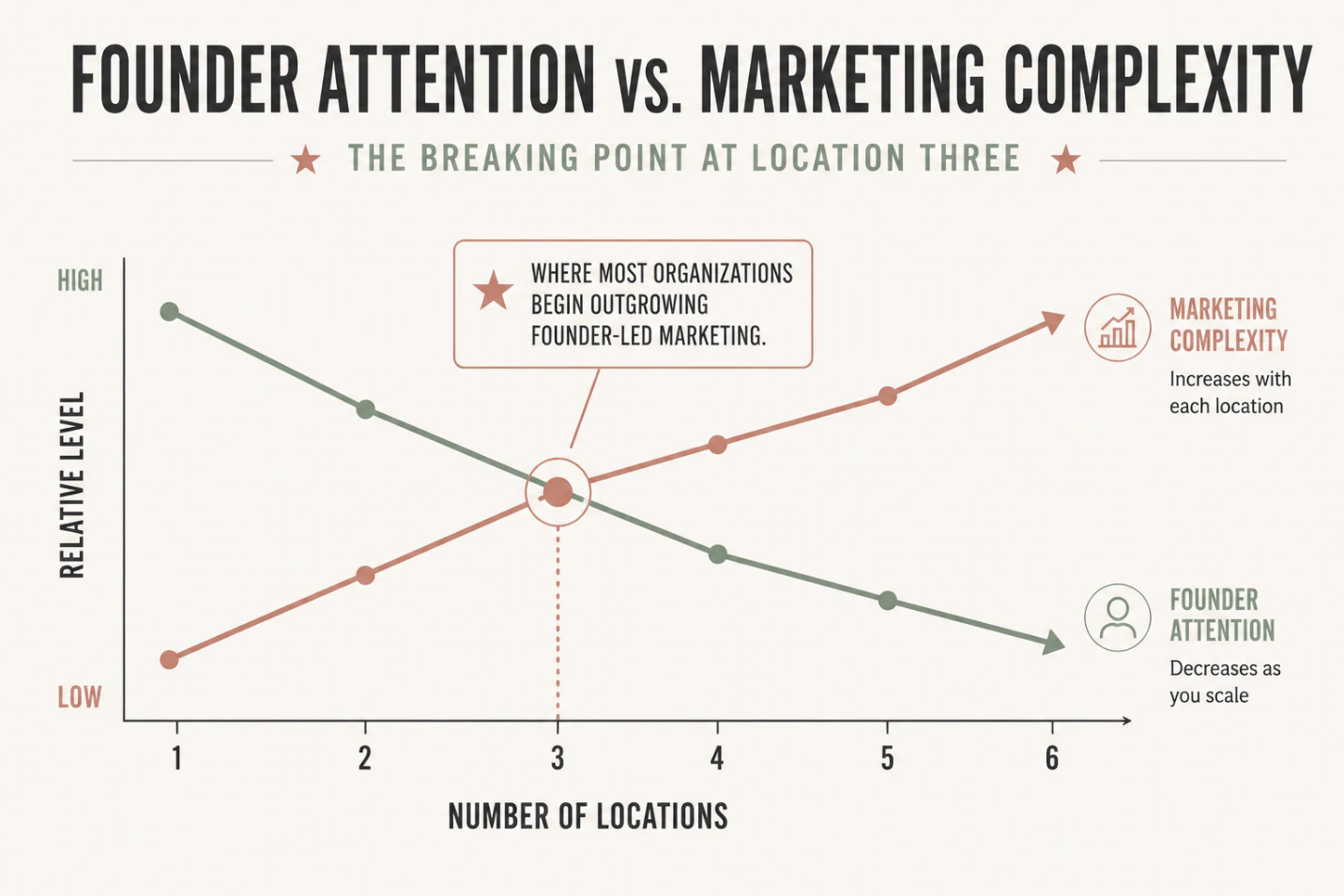
Two locations can survive on founder attention and a shared reputation. The founder can still personally review campaigns, personally know the local competitive market, and personally catch inconsistencies before they become a pattern. Three locations breaks that model, not because of a magic number, but because founder attention is a finite resource and three locations is typically where it runs out faster than the marketing function can compensate.
This is precisely where local SEO and brand consistency infrastructure becomes non-negotiable rather than a nice-to-have. Franchise and multi-location marketing research shows that most operators underestimate how fundamentally different multi-location marketing challenges are compared to running a single location or a fully mature national brand, and that tactics which work for one location break down quickly once an organization is managing dozens of locations, each needing its own Google Business Profile, its own local reviews, consistent name-address-phone data, unique content, and individual performance tracking (Vendasta, 2026). Scaling local SEO across multiple locations creates real, documented challenges around citation consistency, duplicate content, and localized ranking performance, all of which require centralized systems to manage properly (BizIQ, 2026).
The stakes of getting this wrong keep rising because consumer search behavior keeps shifting. Ninety-four percent of high-performing multi-location brands now operate a dedicated local marketing strategy, and AI-driven local search usage among consumers jumped from 6 percent to 45 percent in just twelve months (BizIQ, "Multi-Location SEO Statistics 2026"). A medspa group still running the single-location playbook at location four isn't just underperforming relative to a theoretical best practice. It's actively losing visibility in the exact channels where nearly half of prospective patients are now starting their search.
What Actually Breaks: Four Specific Failure Points
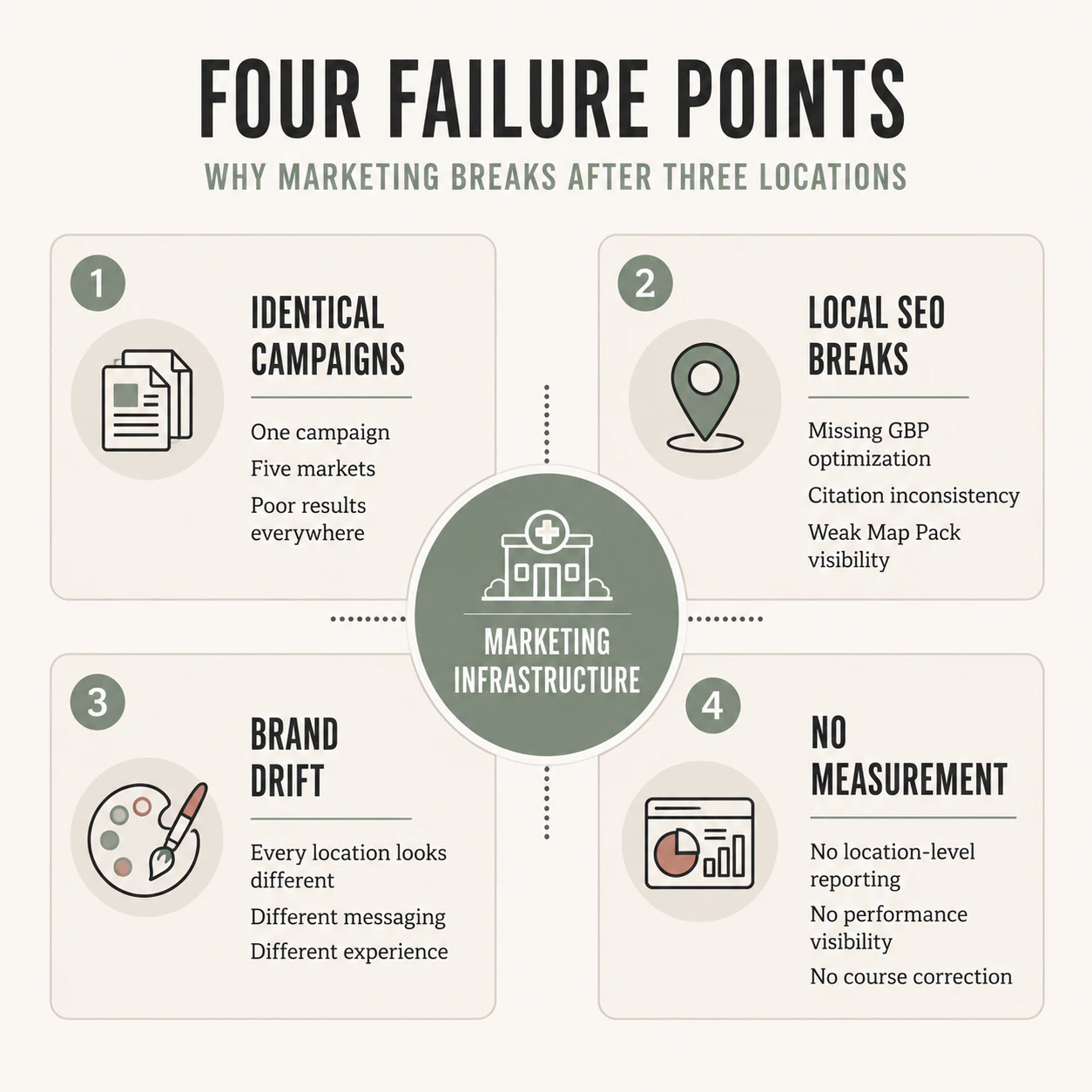
Pulling the research together with what shows up repeatedly in multi-location medspa growth, four specific failures compound past the third location.
1. Identical campaigns across dissimilar markets. The Chatterbuzz case study is the clearest illustration: five locations, five different service mixes, five different patient demographics, five different competitive sets, one identical ad strategy. What converts in an affluent suburban market doesn't convert the same way in an urban market with more direct competition, and a single generic campaign structure guarantees mediocre performance everywhere rather than strong performance somewhere.
2. Inconsistent local search presence. Every additional location needs its own accurate Google Business Profile, its own accumulating base of local reviews, and consistent business information across every directory and citation source. Skip this discipline and a location that "looks fine" on the corporate website is invisible in the exact local map pack results where most patients actually find a provider, a documented failure pattern industry researchers call the multi-location SEO scale problem (BizIQ, 2026).
3. Branding that drifts location by location. Without a centralized brand system, each new location's marketing gets built by whoever happens to be running it locally, whether that's a regional manager, a local agency, or an in-house hire without brand training. The Strategic Voyages case study found this exact drift, inconsistent branding across locations that had never been unified under a single system to begin with (Strategic Voyages, 2024).
4. No centralized measurement across locations. When each location's marketing runs independently, leadership loses the ability to compare performance, spot which market needs intervention, and reallocate budget toward what's actually working. A marketing function built for one location has no mechanism for that comparison at all, because it was never designed to operate across multiple markets simultaneously.
Why This Matters More Now Than It Did Five Years Ago
The consolidation wave sweeping the medspa sector raises the stakes on getting this right. Private equity firms are actively acquiring independent aesthetic clinics and consolidating them into large-scale platforms under unified branding and operations (Nero, 2026), and industry analysts expect 2026 to be a record-setting year for medspa mergers and acquisitions if capital access continues at its current pace (American Med Spa Association, 2026). Currently only about 3 percent of med spas are owned by private equity or PE-backed organizations, which means there is enormous headroom left for consolidation (Scope Research, 2026). For an owner considering an eventual sale or recapitalization, marketing infrastructure that scales cleanly across locations isn't just a growth lever. It's a direct driver of what a platform buyer will pay, because acquirers are specifically looking for proof that growth doesn't depend entirely on founder involvement at every site.
What Founders Get Wrong About Fixing This
The instinct at location three or four is usually to hire a bigger agency, increase ad spend, or add another marketing coordinator. None of those fixes the underlying architecture problem. More ad spend running an identical campaign across dissimilar markets just wastes more money faster. A bigger agency without a location-specific strategy still produces the same generic output, just with a larger invoice attached. What actually needs to be built is a system: centralized brand standards that flex for local market differences, location-specific local SEO discipline applied consistently everywhere, campaigns built around each location's actual demographic and competitive reality rather than a copy-pasted template, and measurement that lets leadership see performance location by location instead of guessing from an aggregate number.
The Question Worth Asking
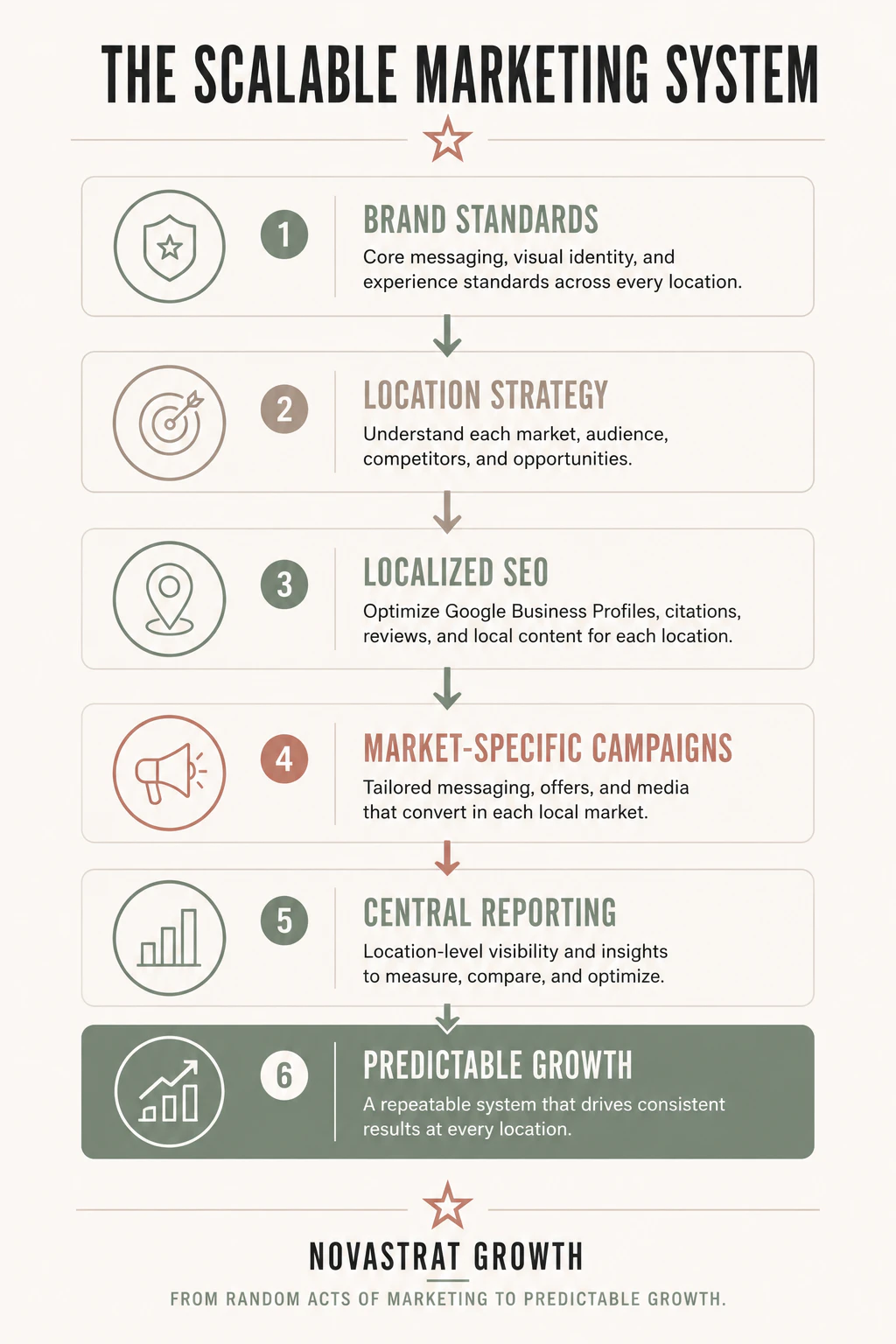
If your marketing worked cleanly through the first two locations and started feeling harder, less predictable, or more expensive per lead somewhere around the third, that isn't a sign you need to work harder inside the same playbook. It's a sign the playbook that built the first location was never designed to run five, and the fix is building the system that can, before the next location makes the gap even more expensive to close.
Sources
Chatterbuzz Media. "Med Spa Marketing Agency for Multi-Location Groups: The 2026 Playbook for Scalable Growth." 2026. https://www.chatterbuzzmedia.com/guide/med-spa-marketing/
Norfolk Daily News. "MedSpa SEO Strategy Drives Multi-Location Medical Practice Growth." 2026. https://norfolkdailynews.com/online_features/press_releases/medspa-seo-strategy-drives-multi-location-medical-practice-growth/article_3db41557-1ec8-5f36-9696-f999ce3fc009.html
Strategic Voyages Business Consultants. "Multi-Location Marketing Challenges for a National Med Spa." 2024. https://svbusinessconsultants.com/2024/09/24/multi-location-marketing-challenges-for-a-national-med-spa/
Vendasta. "Franchise SEO: The Complete 2026 Playbook for Multi-Location Growth." 2026. https://www.vendasta.com/blog/franchise-seo/
BizIQ. "The Multi-Location SEO Scale Problem: Overcoming Local SEO Challenges for Franchises." 2026. https://biziq.com/blog/local-seo-challenges-for-franchises/
BizIQ. "Multi-Location SEO Statistics 2026: Rankings & GBP Data." 2026. https://biziq.com/blog/multi-location-seo-statistics/
Grand View Research. "Medical Spa Market Size And Share, Industry Report, 2033." 2026. https://www.grandviewresearch.com/industry-analysis/medical-spa-market
Mordor Intelligence. "Medical Spa Market Size, Growth - Competitive market 2025-2030." 2026. https://www.mordorintelligence.com/industry-reports/medical-spa-market
Scope Research. "Med Spa and Aesthetics Valuation Multiples and M&A Trends 2025." 2026. https://www.scoperesearch.co/post/med-spa-and-aesthetics-valuation-multiples-and-m-a-trends-2025
Nero. "Med Spa M&A Record 2026: Private Equity Takeover Impact." 2026. https://nero-drbeauty.com/en/news/med-spa-ma-record-2026-private-equity/
American Med Spa Association. "Med Spa M&A and Private Sales: A Look Back at 2025 -- and What Lies Ahead." 2026. https://www.americanmedspa.org/news/med-spa-ma-and-private-sales-a-look-back-at-2025-and-what-lies-ahead/ection: naming location three specifically as the breaking point, backed by two documented case studies showing the exact failure mechanism, gives this piece a diagnostic sharpness that a generic "scaling tips" post could never match.