

By Erika Rosenthal, Novastrat Growth
Word count: 1,560 | Reading time: 7 minutes
Most healthcare companies don't ask "should we hire a CMO" at the right time. They ask it after the symptoms have already cost them something: a stalled pipeline, a board meeting where nobody can explain what marketing is actually doing, a competitor who out-positioned them in a deal they should have won. By the time the question gets asked out loud, the company has usually been running without real marketing leadership for longer than anyone wants to admit.
The decision isn't binary and it isn't just about budget. It's about matching the leadership model to what the business needs right now, not what looks impressive on an org chart.
The Real Cost Comparison
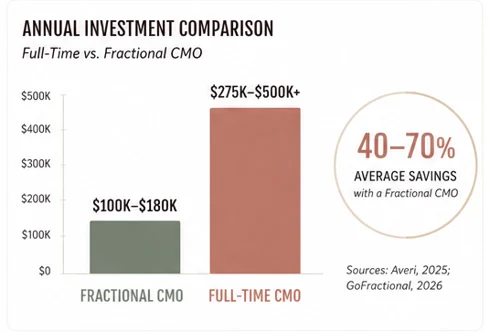
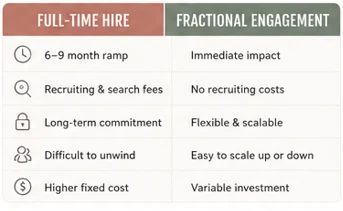
Fractional arrangements, by contrast, typically save companies 40 to 70 percent compared to an equivalent full-time hire, depending on scope and hours (Averi, 2025; GoFractional, 2026). That gap isn't a discount on quality. It's the difference between paying for a full-time seat and paying for the specific hours and outcomes the business actually needs at its current stage.
Why the Math Isn't the Whole Story
Cost is the easiest thing to compare, but it isn't the deciding factor. The deciding factor is risk, specifically the risk of getting the hire wrong. CMO tenure is already the shortest of any C-suite role, averaging around 4.2 years across industries and closer to 3.1 years at many top companies (Behind the CMO, 2026; Statista, 2025). In healthcare specifically, executive turnover carries an even sharper cost, given the average hospital CEO tenure hovers around five years and healthcare leadership transitions are documented to disrupt strategic continuity at a higher rate than in other industries (HCT Healthcare, 2025).
A bad full-time CMO hire doesn't just cost the salary. It costs the six-to-nine-month ramp period before they're productive, the severance or transition cost if it doesn't work out, and the strategic drift while the company waits to try again. A fractional engagement lets a company test fit, scope, and outcomes before committing to that risk, and lets them scale hours up or down as the actual need changes.
When Fractional Is the Right Call

Fractional makes sense in a specific set of situations, and healthcare companies tend to hit more than one of these at once.
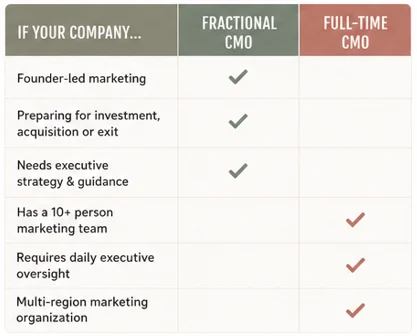
- The company is scaling past founder-led marketing but the volume of strategic work doesn't yet justify a full-time seat. This is the most common trigger. A founder or CEO has been running marketing decisions personally, and the business has outgrown that model, but not to the point where five days a week of executive marketing leadership makes financial sense.
- The company is preparing for a raise, an acquisition, or an exit, and needs marketing positioning and a growth story that will hold up under investor or acquirer scrutiny, without a 12-month executive search delaying the timeline.
- The company wants senior-level marketing judgment applied to an existing team or agency relationship, not a replacement for the people already doing the work, but direction and accountability layered on top of them.
- The company has been burned before by a full-time hire who looked right on paper but didn't fit the specific demands of a regulated, payer-driven healthcare business, and wants to de-risk the next decision.
When Full-Time Is the Right Call
Fractional isn't the answer in every scenario, and a good fractional CMO should tell a client honestly when it isn't.
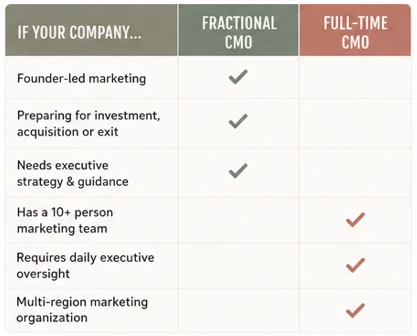
If marketing has grown into a function requiring daily, in-person leadership of a large internal team, five or more direct reports across multiple channels and geographies, a full-time seat usually makes more sense. If the company is at a scale where marketing spend represents a significant enough percentage of revenue that a full-time executive can be fully occupied and directly accountable for it day to day, that's a signal too. And if the company culture or board specifically wants a permanent internal champion embedded in every meeting, a fractional model, however senior, won't fully replace that presence.
The honest answer for most growing and mid-market healthcare companies, though, is that they reach for full-time long before the workload actually requires it, driven more by what looks credible to a board or investor than by what the marketing function actually needs at that stage.
The Cost of Waiting Too Long
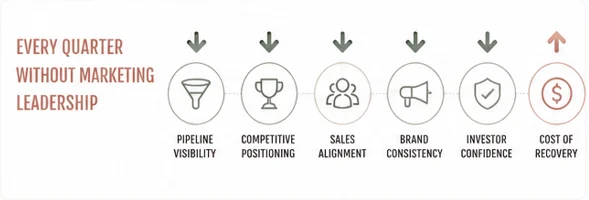
The riskier mistake isn't choosing fractional over full-time or vice versa. It's waiting too long to bring in either one. Every quarter a healthcare company operates without dedicated marketing leadership is a quarter where positioning drifts, competitors out-message them in deals that should have been won, and the eventual hire, whichever model is chosen, has to spend the first several months undoing avoidable damage instead of building.
This is especially true in healthcare, where buyers, whether patients, health systems, or investors, are more skeptical and take longer to move than in most categories. A delayed marketing hire doesn't just delay growth. It compounds the trust deficit a healthcare brand has to close before a sale ever happens.
How Novastrat Growth Fits This Decision
This is exactly the decision Novastrat Growth is built around, not a generic fractional-versus-full-time debate, but a specific answer grounded in operator experience across two documented healthcare exits: a medical device company that grew from $9M to $50M, and a healthcare services company that scaled from $9M to $150M and 65 clinics in under three years. Both were built by someone who owned the P&L, not just the strategy deck, which is exactly the credibility gap a fractional engagement needs to close for it to work.
The Question to Ask Instead
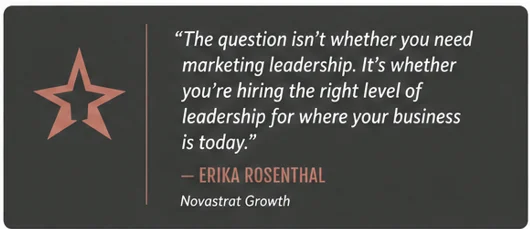
For most growing and mid-market healthcare companies, the honest answer is a fractional CMO who can move at the speed the business needs, prove the model works, and scale into a larger commitment only once the workload actually demands it.
Sources
Averi. "Fractional CMO vs. Full-Time CMO: 2026 Cost Breakdown." 2025. https://www.averi.ai/blog/fractional-cmo-vs-full-time-cmo-cost-analysis-the-complete-2025-guide
GoFractional. "Fractional CMO Salary 2026: Rates, Retainers & Cost Guide." 2026. https://www.gofractional.com/blog/fractional-cmo-salary
Fractionus. "How Much Does a Fractional CMO Cost in the US? (2026)." 2026. https://fractionus.com/blog/fractional-cmo-cost-us
Behind the CMO. "CMO Tenure Statistics (2026)." 2026. https://www.behindthecmo.com/resources/cmo-tenure-statistics/
Statista. "U.S. Top Advertisers' CMOs' Average Tenure." 2025. https://www.statista.com/statistics/693846/cmo-tenure-usa/
HCT Healthcare. "Understanding Hospital CEO Turnover: Trends, Challenges and Strategies for Healthcare Executives." 2025. https://www.hcthealthcare.com/industry-insights/hospital-ceo-turnoverection: