

By Erika Rosenthal, Novastrat Growth | Reading time: 17 minutes
Why brilliant science often loses commercial momentum, and how healthcare leaders can restore clarity without sacrificing clinical credibility
Some of the most difficult medical devices to commercialize are also some of the most impressive.
They are created by scientists, engineers, physicians and clinical experts who have spent years solving difficult problems. Their organizations understand the technology at an extraordinary level of depth. They know the mechanism of action and understand the engineering. They can explain the clinical literature, product specifications, patient populations, contraindications, workflows and competitive differences.
Then, something happens as the company grows. The organization learns more. The message gets longer.
Clinical Affairs adds another study. Engineering adds another capability. Regulatory refines the claims. Product Management adds new specifications. Marketing creates collateral for additional audiences. Sales develops competitive responses based on what it hears in the field. Almost every addition is legitimate.
Collectively, however, the company can begin to lose something important: the story. Complexity increases. Meaning decreases. I have seen this happen in medical-device companies with genuinely differentiated technology and credible clinical evidence. The organization becomes increasingly sophisticated in explaining how the device works while becoming less effective at explaining why it matters.
That creates a commercial problem; not because hospitals don't value evidence, because they absolutely do. Evidence is fundamental to medical-device evaluation. Hospital purchasing and value-analysis processes explicitly consider clinical evidence alongside quality, outcomes, cost, reimbursement and other factors. (AHRMM)
The problem is that evidence alone cannot do all the work required to move a complex organization toward adoption. Someone still has to understand it. Someone has to determine its relevance. Someone has to translate the clinical findings into implications for patients, clinicians, operations, and economics.
Eventually, multiple people with different responsibilities must become sufficiently confident in the decision to move forward. That takes time. It consumes resources. When a medical-device company makes that process unnecessarily difficult, it creates what I call Decision Friction. Decision friction gets in the way of converting a prospect to a customer. Many times, marketing, and even sales, will try and pack as much information as possible into a sales deck. In meetings where multiple stakeholders are making decisions, the process can break down. Even getting to the meeting with stakeholders can break down if the emphasis is on the entire story instead of just trying to get to the next step. It creates information overload and complexity.
Complexity Has a Cost
Complexity itself is not the enemy. Medicine is complex. Science is complex. Hospital operations are complex. The clinical evidence supporting an innovative technology may necessarily be complex. Oversimplifying that evidence can be irresponsible and, in a regulated industry, potentially dangerous.
The problem is unnecessary complexity.
There is a cognitive cost associated with asking someone to determine what matters from a large amount of information. Consider the different people who may become involved in evaluating a new medical technology:
- A physician may want to understand efficacy, safety and clinical outcomes.
- A nurse or technologist may want to know how the device affects workflow and whether it can be used reliably during a busy shift.
- A Value Analysis Committee may evaluate clinical outcomes, quality and cost.
- Supply Chain may need to understand contracts, disposables and standardization.
- Finance may evaluate budget impact and total cost of ownership.
- Biomedical Engineering may want to understand calibration, maintenance, reliability and service requirements.
- An executive may want to know whether the technology meaningfully advances a strategic clinical or operational priority.
These aren't less sophisticated questions than the science. They are different questions. They don't necessarily arise in a predictable sequence.https://www.gartner.com/en/sales/insights/b2b-buying-journey?utm_source=chatgpt.com
Research into complex B2B buying supports this broader reality. Gartner describes today's B2B buying process as non-linear, with buying teams repeatedly revisiting activities such as problem identification, solution exploration, requirements building, supplier selection, validation and consensus creation rather than progressing through a neat sequence of stages. (Gartner)
Hospital technology purchasing adds another layer because the stakes can include patient outcomes, safety, cost and operational performance. Research on hospital medical-device purchasing describes processes involving clinicians, finance and administrative leaders, with evaluation criteria explicitly encompassing clinical and financial considerations. (PubMed)
Yet many medical-device sales organizations still equip their teams as though the buying journey were linear.
- Learn the product
- Deliver the presentation
- Provide the evidence
- Handle the objections
- Demonstrate the device
- Submit the proposal
- Close the sale
Real hospital decisions rarely behave in that linear manner.
The Real Competitor May Be the Status Quo
Medical-device companies spend considerable time positioning themselves against competitors.
Sometimes the most formidable competitor isn't another manufacturer.
It is: Do Nothing.
- Evaluating a new medical device is work.
- Someone has to read the evidence.
- Someone may have to build the business case.
- Clinical stakeholders need to become involved.
- Value Analysis may need to review it.
- Supply Chain may need to assess it.
- Biomed may need to evaluate it.
- Users may need training.
- Protocols may change.
- Inventory may change.
- Existing equipment may need to be replaced or redeployed.
A new technology can therefore be clinically compelling and still encounter organizational resistance, and not necessarily because anyone opposes the technology. The existing system already works well enough to avoid the work associated with changing it. This distinction matters enormously for medical-device leadership.
If your organization believes its commercial responsibility is simply to demonstrate product superiority, you may continue producing more evidence, more slides, and more feature comparisons; however, if you recognize that the hospital is being asked to undertake a decision process, the leadership question changes:
How can we make a rigorous decision easier to make without making the decision less rigorous?
That is a very different commercial mandate.
Evidence Is Essential. It Just Isn't the Whole Story.
There is a dangerous version of "simplification" in medical-device marketing that reduces clinically sophisticated products to superficial taglines. That is not what I am advocating.
Hospitals need compelling evidence that is greater than the status quo.
- AHRMM explicitly supports comparative-effectiveness research as a means of providing evidence-based data for healthcare purchasing decisions, including evaluating efficacy, cost-effectiveness, patient outcomes and lifecycle management. (AHRMM)
- A published case study from Vanderbilt described a physician-driven technology assessment process using evidence-based, clinically sound and financially responsible methodologies. The initiative reported reductions in physician-preference-item costs of 11% to 26% across service lines and annual savings greater than $8 million.(PubMed)
The point isn't that clinical evidence matters less. The point is that clinical evidence deserves an architecture that helps the appropriate stakeholders understand why it matters.
Think about the resources required to interpret sophisticated clinical evidence correctly. The clinician reading the study may understand its methodology and endpoints immediately. Other stakeholders may not. They shouldn't need to become clinical researchers to understand the implications of the research for their responsibilities. The manufacturer's job is not to dilute the evidence. It is to make its relevance accessible. This leads to a principle I believe applies well beyond medical-device commercialization:
Leadership reduces complexity without reducing truth
The objective isn't to remove complexity from the science. It is to remove unnecessary complexity from the process of understanding it.
From Product Explanation to Commercial Story
There comes a point in the growth of many medical-device companies when leadership needs to stop adding to the message and step back from it. The question becomes less:
What else should we tell customers?
And more:
What story are we trying to tell?
Start higher.
- Why does the company exist?
- What problem in patient care was important enough to solve?
- Is it aligned with what the hospital’s major mandates are?
- What changes when the technology works as intended?
- Does it help clinicians intervene earlier?
- Does it improve diagnostic accuracy?
- Does it reduce adverse events?
- Does it improve patient outcomes?
- Does it reduce unnecessary utilization?
- Does it make a difficult clinical process easier or safer?
- What is the higher purpose connecting the company, technology and customer?
Only then should the organization descend into the supporting evidence.
That is where I use a structure I call the Clinical Messaging Pyramid.
VISUAL 1:
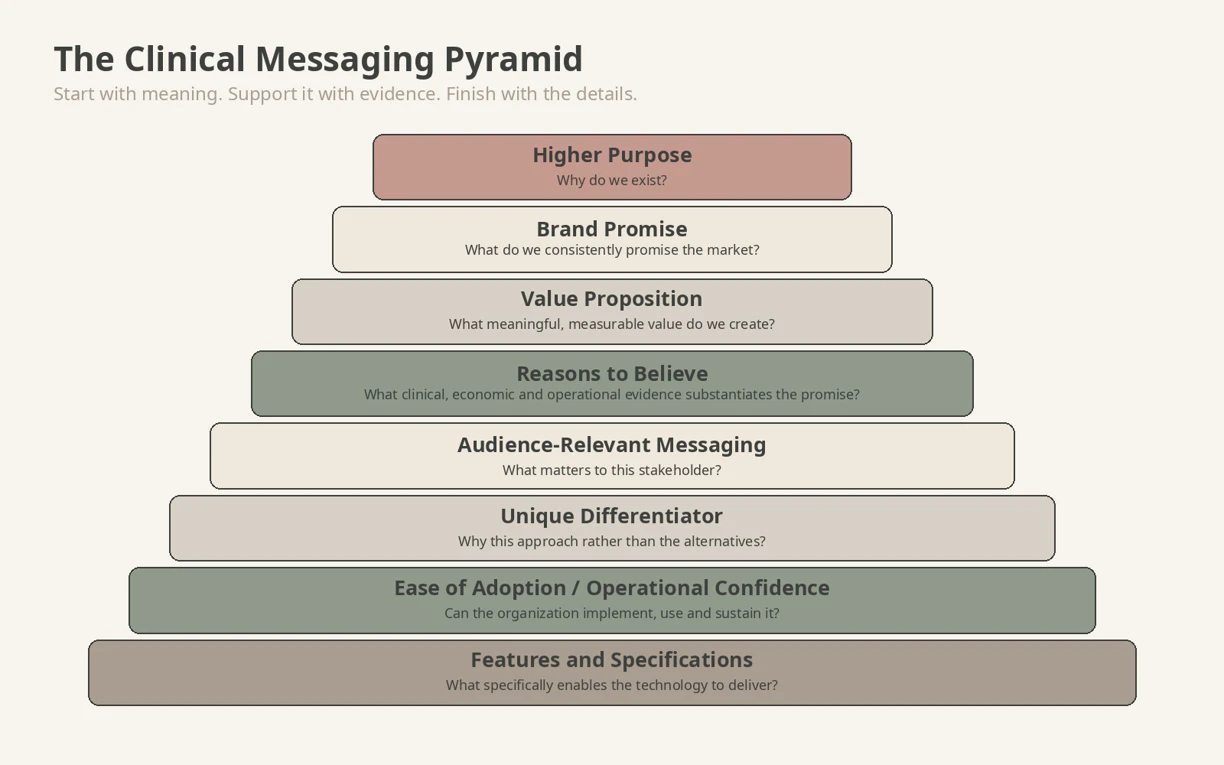
The exact message will vary by device and market. The hierarchy matters more.
Features should support the story. They should not become the story.
Reasons to Believe Must Remain Rigorous
One of the easiest mistakes to make when simplifying medical-device messaging is reducing "Reasons to Believe" to a collection of broad marketing claims, often with quantitative proof points.
- Better outcomes.
- More efficient.
- Easy to use.
- Cost-effective.
Those are assertions. They aren't reasons to believe. Whenever the evidence allows it, quantitative proof is stronger:
- Reduction in adverse events.
- Improvement in diagnostic accuracy.
- Reduction in length of stay.
- Reduction in rehospitalizations.
- Improvement in time to intervention.
- Reduction in resource utilization.
- Lower disposable cost.
- Reduced maintenance requirements.
- Faster time to competency.
- Improved uptime.
- Economic impact.
The specific measures will depend entirely on the technology and the quality of available evidence. In addition, a medical device company willing to partner with the hospital and help them to quantify these changes is worth a great deal to an already stretched-thin hospital staff.
The discipline should remain the same:
Make the value proposition simple. Make the proof rigorous.
Those aren't competing objectives. They're complementary.
One Device. Multiple Definitions of Value.
The Clinical Messaging Pyramid provides a common story. It does not mean every stakeholder receives the same conversation. This is where sophisticated medical-device selling differs from simply creating better collateral. Imagine a device that generates data supporting a time-sensitive clinical decision.
- The physician may ask: Does the information improve the quality or speed of my clinical decision?
- The technologist operating the device may ask: How difficult is it to use accurately?
- Nursing may ask: What does this add to the workflow?
- Biomed may ask: How often does it need to be calibrated, and who can service it?
- Supply Chain may ask: What are the disposable requirements and recurring costs?
- Finance may ask: What is the total economic impact?
- Hospital leadership may ask: Does this materially improve the standard of care or advance one of our strategic priorities?
Same device. Same evidence base. Same value proposition. Different decision requirements. That distinction is essential.
A medical device sales force is one of the company's most expensive commercial investments. When field talent has to rebuild the story, locate evidence, or educate each stakeholder from scratch, commercial capacity is lost. Arming the sales force with a coherent story and the right supporting resources can improve selling efficiency and may help reduce customer acquisition cycle time, customer acquisition cost (CAC), and time to adoption and utilization.
Operational Confidence: Show That You Understand the Buyer's World
Medical-device companies often devote extraordinary attention to clinical differentiation and comparatively little attention to what happens after the purchase order is signed. Hospitals cannot afford that luxury. They have to live with the device. Operational Confidence, therefore, deserves a deliberate place in the commercial story. Rather than overwhelm the customer with operational detail, the commercial team should be able to answer the questions that matter most:
- User: Who actually operates the device? Is it a nurse, respiratory therapist, medical technologist, surgical technologist, perfusionist or physician?
- Learning: How quickly can that person become competent? Is the device intuitive? What happens when an infrequent user needs it?
- Workflow: What does the device add, remove or change in the clinical workflow? Does it help without adding unnecessary complexity?
- Clinical decision support: Does it produce information used to make a clinical decision? Who interprets it? How quickly is the information available? How accurate must it be? Can it contribute to avoiding an adverse event?
- Availability and mobility: Where does the device need to be located? Can it move between departments? Will it be available when it is needed most?
- Ownership:What are the requirements for calibration, preventive maintenance, consumables, service, downtime, software updates, storage, cleaning and expected useful life?
These details aren't beneath the strategic story. They demonstrate that the manufacturer understands the customer's reality. It is the difference between a transactional sale and behaving like a long-term partner.
AHRMM's current product-value-analysis curriculum similarly describes hospital purchasing as encompassing patient needs, standardization, clinical evidence, outcomes, quality, cost and reimbursement rather than price or clinical performance alone. (AHRMM)
VISUAL 2:
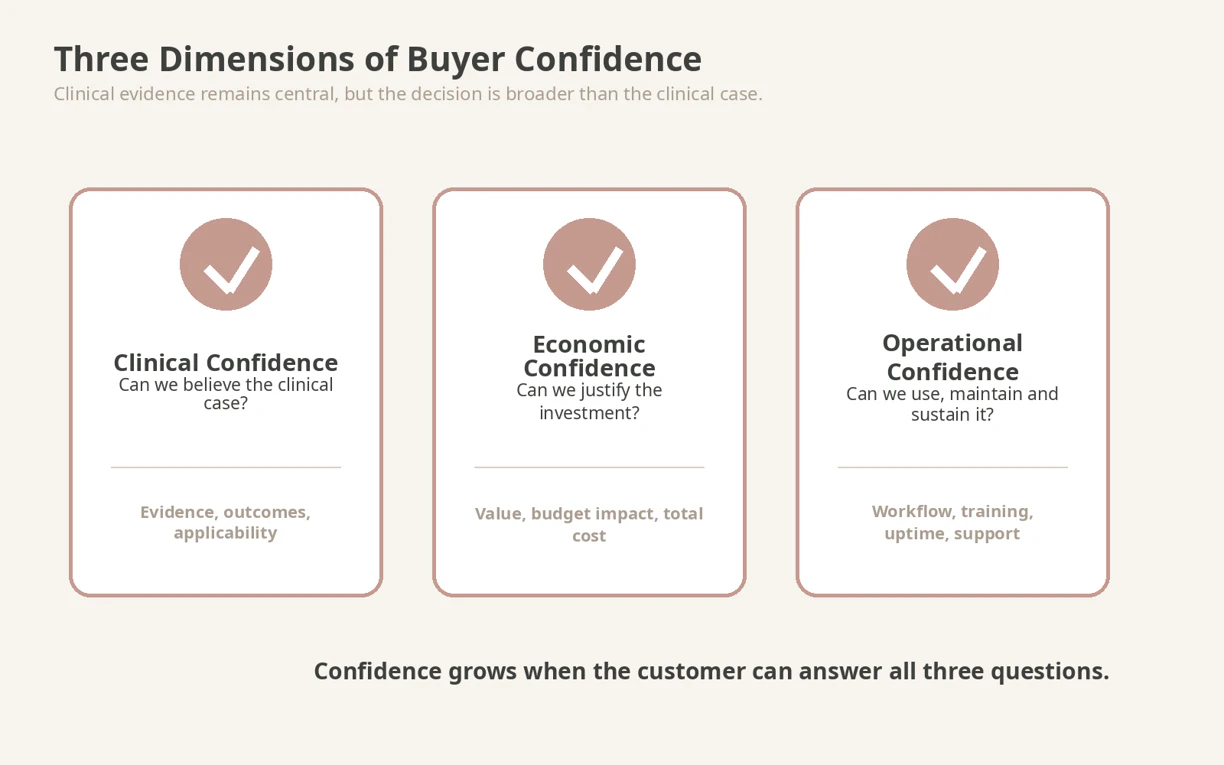
The evidence runs through all three. Clinical evidence isn't replaced by this model. It is contextualized within the broader decision.
The Cognitive Cost of Understanding
There is another cost that rarely appears in a medical-device business case. The cost of understanding. There is a cost, every time:
- A stakeholder has to search through 40 slides to find the three that matter
- The salesperson sends six clinical papers without explaining which one addresses the customer's concern
- Clinical Affairs, Marketing and Sales describe the same technology differently
- A committee has to reconvene because a basic operational question wasn't anticipated
- The customer has to translate the manufacturer's science into its own business case
I call this Cognitive Cost: the mental effort required for a stakeholder to identify, understand, and apply the information necessary to evaluate a decision. Not all cognitive costs can or should be eliminated. The goal is to remove what is unnecessary. Unnecessary cognitive cost contributes to something more commercially consequential.
Decision Friction.
Decision Friction: Why Good Opportunities Stall
I define Decision Friction as:
The cumulative resistance that prevents stakeholders from confidently moving a decision forward.
Messaging complexity can create decision friction. Messaging complexity that isn’t aligned to hospital key objectives can cause decision friction; however, it is only one source.
- Decision friction may be clinical: "We aren't convinced the evidence applies to our patient population."
- It may be economic: "We understand the clinical benefit, but we can't justify the investment."
- It may be operational: "We like it, but nursing believes implementation will be difficult."
- It may be organizational: "Our clinical champion wants it, but we haven't created consensus."
- It may be informational: "Everyone keeps giving us different explanations."
Or it may simply be inertia: "This looks interesting, but replacing what we're doing today isn't a priority." This is why I would resist a simplistic formula claiming:
More complexity = longer sales cycle.
Reality is more nuanced. A sophisticated technology can move quickly when the problem is urgent, the value is clear, the evidence is compelling and the organization has confidence in implementation.
A relatively simple technology can stall indefinitely when nobody believes change is worth the effort.
The more useful relationship is:
VISUAL 3:
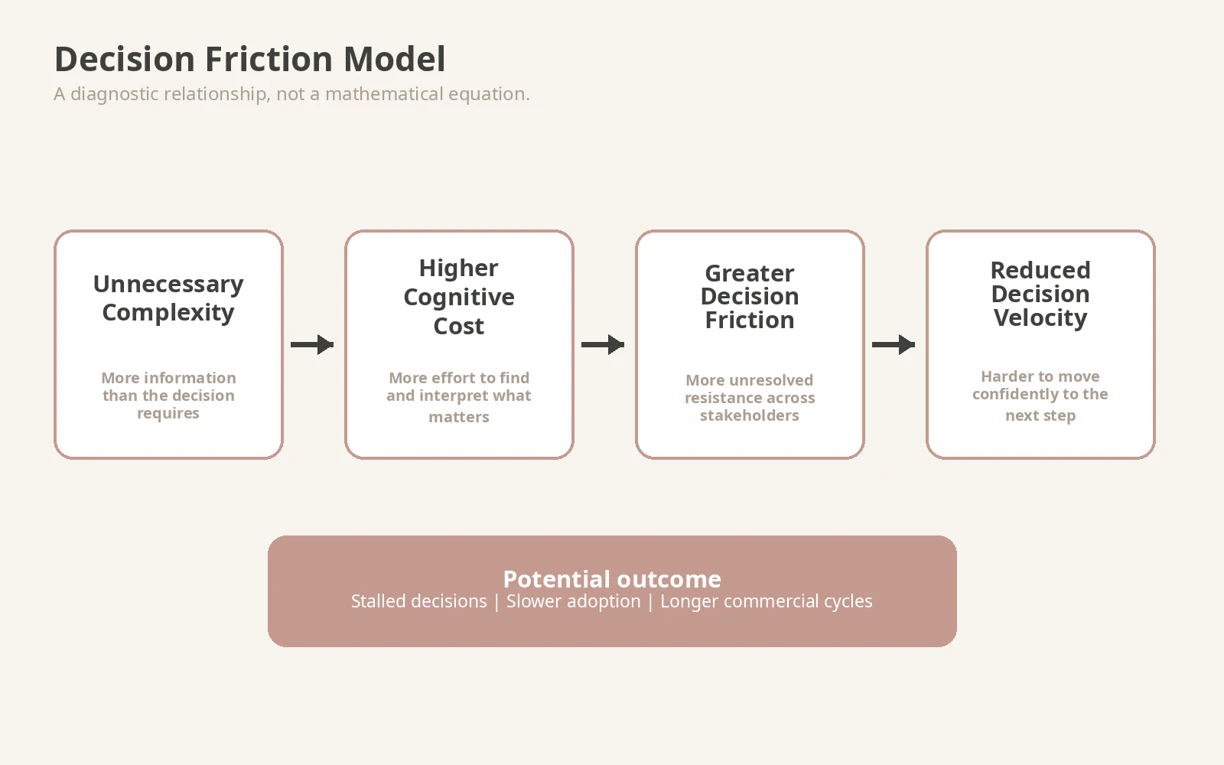
This is not intended as a mathematical equation. It is a diagnostic relationship. And that distinction matters.
Stop Giving Experienced Salespeople Linear Scripts
This brings us to a leadership problem. Many medical-device sales guides remain linear.
- Step one.
- Step two.
- Step three.
- Ask this question.
- Present this slide.
- Handle this objection.
- Advance to the next stage.
Process discipline has value. Regulatory requirements matter. Consistency matters. A rigid script can underestimate both the complexity of the customer's decision and the intelligence of the salesperson.
Complex B2B buying does not occur in a predictable linear sequence. Gartner's research specifically describes buying teams moving back and forth among buying tasks, and recommends helping buyers complete the tasks necessary to reach a confident decision rather than treating the journey as a simple progression through seller-defined stages. (Gartner)
That is remarkably relevant to medical-device commercialization.
An experienced salesperson sitting across from a hospital stakeholder needs something more useful than: "You are now in Stage 4."
They need to understand: Where is the friction?
- Perhaps the physician is convinced but the technologists aren't.
- Perhaps the economic case works but Biomed has concerns.
- Perhaps everyone likes the technology but nobody has created enough urgency to displace the status quo.
- Perhaps the stated objection is price, while the unspoken concern is implementation.
People do not always vocalize what matters most to them. Great salespeople know this intuitively.
- They listen.
- They observe.
- They test assumptions.
- They recognize what isn't being said.
And then they access the evidence, story, customer example, operational resource, or economic tool that helps the customer address the issue at hand. Leadership should make that easier.
From Sales Playbook to Decision Architecture
This is where I believe medical-device commercial leadership needs to evolve.
Instead of giving salespeople a rigid path, give them an architecture they can navigate.
VISUAL 4:
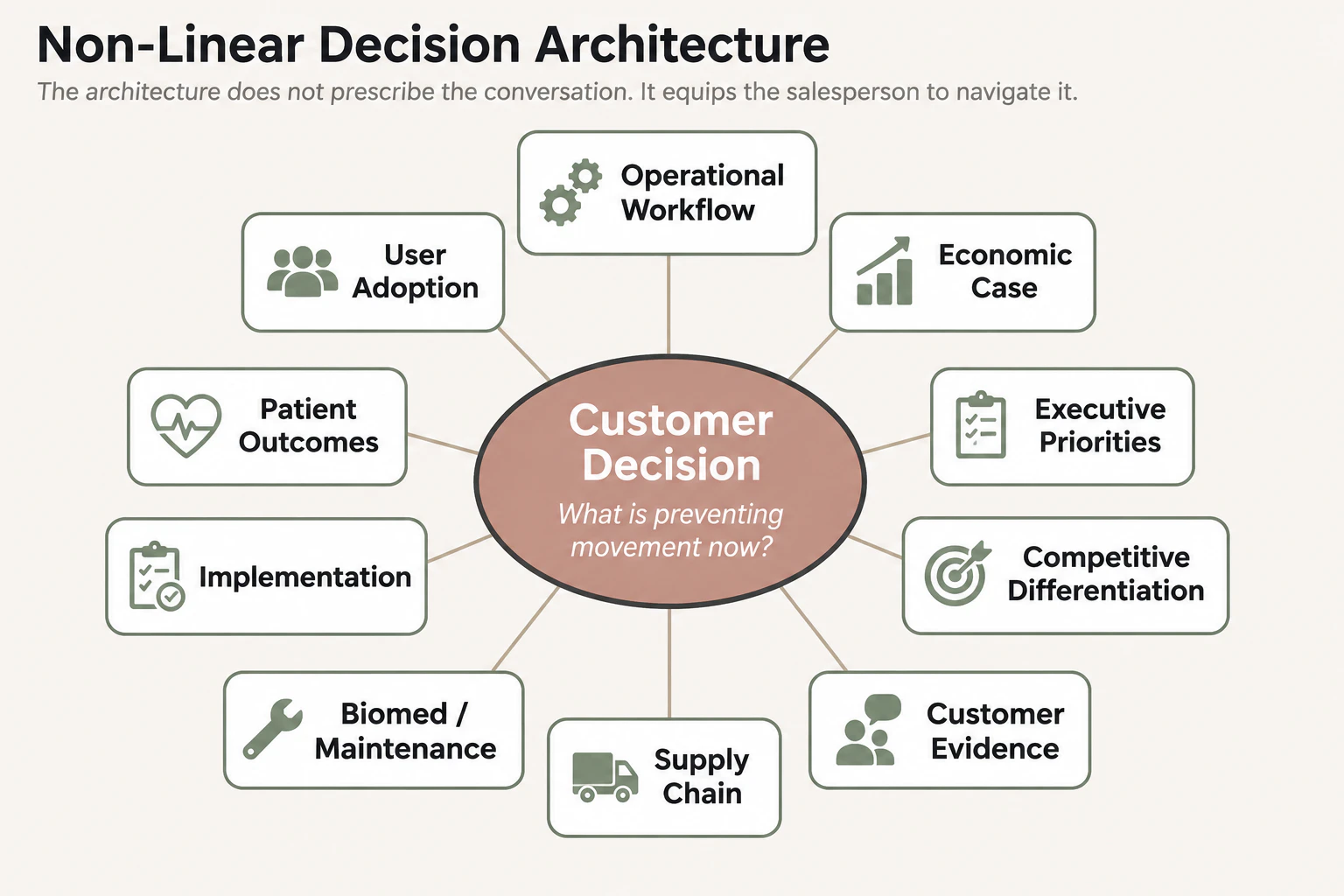
- The salesperson doesn't move clockwise around the diagram. They navigate it.
- A concern emerges about training? Access the user-adoption tools.
- A CFO enters the conversation? Move to economic evidence.
- Biomed asks about calibration? Use the operational materials.
- A physician questions applicability? Return to clinical evidence.
- A committee isn't convinced change is necessary? Reestablish the patient, clinical or operational problem and the cost of maintaining the status quo.
The architecture doesn't prescribe the conversation. It equips the salesperson to navigate it. That respects the intelligence of experienced commercial professionals while giving less-experienced representatives a structure within which to develop judgment. In addition, it allows the company to maintain one coherent story without demanding one identical conversation.
Applied Marketing: Make Strategy Usable
A company can have excellent positioning and still make selling unnecessarily difficult. The value proposition may live in a marketing presentation. The clinical evidence may sit in a document library. The economic model may exist, but the sales team may not know when to use it. Implementation resources may not appear until after the customer has already worried about implementation.
This is where Applied Marketing matters. Applied Marketing is the translation of strategy into practical resources that help people act.
In medical-device commercialization, that means giving the sales team a coherent core story and access to the evidence or resource that fits the decision in front of them. A clinical concern may call for the right evidence summary. A workflow concern may call for a peer-user example. A Biomed concern may call for maintenance and calibration information. A status-quo concern may require the team to reestablish why change matters at all. The goal is not to create a tool for every conceivable objection. That simply creates another form of complexity. The goal is to make the right support easy to find and use when it matters.
The Emerging Decision Friction Diagnostic
Rather than asking whether the company has "good messaging," leadership can ask where customer decisions repeatedly encounter resistance. A useful diagnostic should examine four broad areas:
- Clinical friction: Is the evidence credible, relevant and easy for the appropriate stakeholder to access and understand?
- Economic friction: Can the customer understand the financial implications, including total cost of ownership and economic value where the evidence supports it?
- Operational friction: Can the hospital picture how the device will be used, implemented, maintained and supported?
- Organizational friction: Are the internal and customer stakeholders sufficiently aligned to move the decision forward?
I would resist creating a sophisticated scoring formula before we know what deserves to be measured. First identify the observable friction. Then determine which measures reliably predict stalled or advancing decisions.
First prove the model. Then instrument it.
Start With Three Stalled Decisions
There is a simple way to begin without a formal diagnostic. Pull the last three meaningful hospital opportunities that stalled. Not necessarily the three you lost. The three where movement stopped. For each one, ask:
- Where did the decision stop moving?
- Who was involved at that point?
- What did the sales team believe was preventing movement, and what evidence do you have that this was the real concern?
- Was the unresolved friction clinical, economic, operational, organizational or simply the perceived effort required to change?
- What did your company provide to help the customer resolve it?
- Did that resource answer the customer's question, or did it simply give the customer more information?
Then ask the most important question:
What work did we leave the customer to do themselves?
Perhaps the customer had to calculate the economic impact. Perhaps the physician champion had to explain the technology internally. Perhaps nursing had to determine the workflow implications. Perhaps Biomed had to hunt for maintenance requirements. Perhaps nobody helped leadership understand why maintaining the status quo carried a cost of its own. If the same friction appears across multiple stalled opportunities, you may not have a salesperson problem. You may have an architecture problem.
A Leadership Responsibility, Not Just a Marketing Responsibility
It would be easy to classify all of this as a messaging problem. I don't think that's accurate. Marketing may build the architecture. Sales may use it. Clinical Affairs may substantiate it. Product may inform it. Medical Affairs may protect its scientific integrity. Leadership has to decide that making the customer work unnecessarily hard is unacceptable. That is a leadership choice.
Medical-device companies should continue producing rigorous evidence. Scientists should continue advancing the science. Engineers should continue improving the technology. Clinical teams should continue challenging claims and generating evidence. Simplification should never become an excuse for superficiality. Leadership has a different responsibility: organize the complexity.
Give people a coherent story. Make the evidence accessible without diminishing it. Help each stakeholder understand what the technology means for their role. Give salespeople the tools to navigate a non-linear decision rather than forcing them through a linear script. Reduce unnecessary friction between a clinically meaningful innovation and the patients who may ultimately benefit from it. This is where medical-device messaging becomes something larger than marketing. It becomes decision architecture.
The Standard Should Be Higher
A sophisticated medical-device company should be able to answer several questions clearly:
- Can we explain why this company exists without mentioning a feature?
- Can we state the value proposition in language a hospital executive understands?
- Can we substantiate it quantitatively?
- Can our salespeople tell the same fundamental story without sounding scripted?
- Can clinicians quickly access the evidence relevant to their questions?
- Can users understand how the device will affect their workflow?
- Can Finance understand the economics?
- Can Biomed understand the ownership burden?
- Can Supply Chain understand recurring costs?
- an leadership explain why changing from the status quo is worth the organizational effort?
And when the decision stalls, can the commercial team identify where the friction is occurring? If not, adding another sales deck probably isn't the answer.
From Evidence to Action
The medical-device industry has no shortage of brilliant technology. Nor should anyone argue that sophisticated science needs to become simplistic. The commercial challenge is different.
Hospitals are being asked to evaluate increasingly sophisticated technologies in environments where clinical, economic and operational pressures compete for finite attention and resources. The evaluation itself requires work. Medical-device leadership can either add to that burden or help reduce it. The companies that do this well won't necessarily communicate less.
- They will communicate with greater architecture.
- They will know what must remain rigorous.
- They will know what can become simpler.
- They will distinguish the core story from the supporting evidence.
- They will recognize that different stakeholders require different forms of confidence.
- And, they will equip their commercial teams to navigate the decision rather than recite the presentation.
Because ultimately: Great leaders don't simplify because their organizations are simple. They simplify because the decisions their organizations face are complex.
"If you can't explain it simply, you don't understand it well enough." — Often attributed to Albert Einstein (attribution is uncertain)
Medical devices are an unusually powerful proving ground for this principle because the decisions are high-stakes, multidisciplinary, evidence-driven and operationally complex. If leaders can reduce Decision Friction here without compromising scientific rigor, the principle has implications far beyond medical-device commercialization.