


Marketing Medical Devices to Hospital Value Analysis Committees: What Moves the Decision
A medical device company can have superior clinical data, a compelling price, and a physician champion who genuinely wants the product in the OR tomorrow, and still watch the sale die in a conference room none of its sales reps ever enter.
That room belongs to the Value Analysis Committee.
Understanding how it thinks, not how a sales deck assumes it thinks, is now the single biggest lever most medtech companies are underusing. This is not a niche procurement detail. It is the decision-making architecture that determines whether a device reaches a single patient inside a hospital system.
Get it wrong, and the best product in the category sits outside the formulary. Get it right, and it becomes the reference standard for outcomes and reimbursement conversations that outlast any individual sales cycle.
What a Value Analysis Committee Is
Picture a long conference table. Around it sits a surgeon still in scrubs, a finance director with a laptop open to a spreadsheet, a supply chain manager holding a vendor dossier, an infection control nurse, and sometimes a hospital attorney. They meet once a month, sometimes less. They have 90 minutes to review a stack of product submissions thicker than most of them have time to read.
This is a Value Analysis Committee.
A VAC is a multidisciplinary group inside a hospital or integrated delivery network responsible for evaluating whether a product, technology, or service should be approved for use, separate from the purchasing or supply chain function that later executes the buy. Provyx Where purchasing negotiates price and terms, the VAC decides whether the product earns a place in the hospital at all.
The committee's core mandate is to ensure that every product considered provides a genuine, demonstrable value proposition, not simply a marginal improvement dressed up in better packaging. symplr A typical VAC pulls together physicians, nurses, purchasing agents, finance representatives, infection control staff, and sometimes legal or risk management, each bringing a different lens to the same product. Kinmed
This structure exists because the old model broke. Before VACs became standard, a single influential surgeon could effectively greenlight a purchase through relationship and reputation alone. That created blind spots hospitals could no longer afford: devices approved on one clinician's enthusiasm, with no systematic check on cost, safety, or actual clinical benefit. World Health Expo
VACs formalized what used to be informal. In doing so, they changed what "winning" a sale requires.
Why This Is Now the Dominant Adoption Gatekeeper
The scale of VAC influence is easy to underestimate from outside a hospital's walls.
Any category of technology can undergo VAC review: capital equipment, implantable devices, disposable supplies. Almost nothing enters clinical use without first clearing this committee's evaluation. MD+DI
VAC review also does not operate in isolation. It exists alongside group purchasing organization contracts that already cover the vast majority of hospital supply spend. Ninety-seven to ninety-eight percent of U.S. hospitals are affiliated with at least one GPO, and GPO-negotiated contracts can influence close to 60 percent of non-labor hospital and nursing home spending. Global Supply Chain Institute Healthcare Finance News A device that clears VAC review still often needs a path through GPO contracting to reach the shelf at scale, and manufacturers frequently need separate value analysis approval at every individual institution or IDN, even when a national GPO agreement already exists. ScienceDirect
This is precisely the dynamic Gartner has documented across complex B2B purchasing generally: a typical buying group for a complicated purchase now includes somewhere between 6 and 13 stakeholders, each arriving with 4 to 5 pieces of independently gathered research before the group ever convenes as a body. Gartner via Traction Complete Attainment Labs
A VAC is essentially a healthcare-specific, higher-stakes version of exactly that pattern. Except the "buyers" also carry clinical, safety, and regulatory responsibility that a typical enterprise software buying committee never has to weigh.
The Timeline Problem Most Medtech Companies Underestimate
Here is where sales forecasts routinely go wrong.
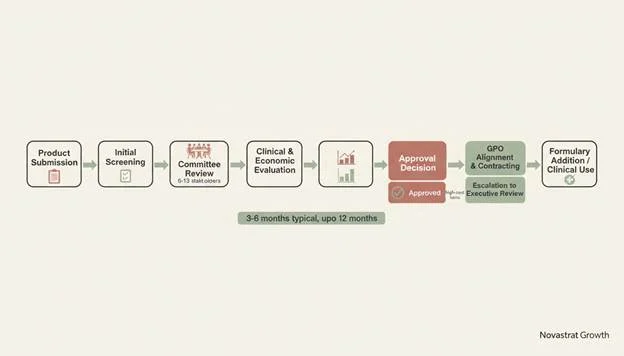
VAC approval is not a fast process. Companies that model it like a typical enterprise sales cycle consistently misjudge both timeline and required investment. In many organizations, approval can take three to six months; in others, the process stretches toward a full year. Accretive Edge
Part of the delay is structural rather than a reflection of vendor quality. Many VACs meet only monthly. Some meet only quarterly. A single missed submission deadline can cost a manufacturer three additional months before the next opportunity to be heard.
Imagine a calendar: your product submission lands the day after the April meeting. The committee does not reconvene until late May. Review gets pushed to June because the agenda is already full. By the time you present, it is summer. Key stakeholders are on vacation. Final approval comes in September, if nothing else slows it down.
Capital equipment adds another layer of complexity. In many facilities, a VAC will not even place a capital purchase on its agenda until a physician has already established interest and the item has been budgeted. In other institutions, VAC approval is required before the hospital will budget for the technology at all. RC Capital
That sequencing question, does clinical champion interest come first, or does committee approval come first, is one of the earliest and most consequential things a manufacturer needs to learn about a specific institution. Guessing wrong wastes months.
The process does not always end with the VAC itself. For higher-cost capital purchases, the final recommendation often moves up to an even higher committee or to hospital executives who hold ultimate purchasing authority. Ghost Productions A manufacturer that treats VAC approval as the finish line, rather than one gate in a longer sequence, is routinely surprised by a second round of scrutiny it did not budget time or evidence for.
What Moves the Decision: The Shift From Clinical Story to Economic Proof
This is the strategic reality that separates companies that win VAC approvals repeatedly from those that treat every institution as a fresh, unpredictable fight.
Bain's research on the medtech commercial model is blunt about the underlying market shift: genuine clinical differentiation is diminishing across many product categories, even as the bar for what counts as valuable innovation keeps rising. Bain & Company This dynamic is especially pronounced in the largest medtech profit pools like cardiac care.
In plain terms, "our device is clinically a little better" is no longer a sufficient argument on its own. Most competitors in mature categories can make a similar claim. VACs have gotten more sophisticated at recognizing marginal claims dressed up as breakthroughs.
What fills that gap is health economics and outcomes research, commonly called HEOR.
HEOR generates the actual evidence that payers, hospital administrators, and technology assessment bodies use to determine whether a device is genuinely worth the investment, not just clinically interesting. Buzzbox Media That evidence gets built specifically to answer the questions a VAC is structurally designed to ask:
- Does this reduce total cost of care?
- Does this reduce length of stay or readmission risk?
- Does this change downstream resource utilization in a way the hospital's own finance team can verify?
HEOR findings get presented directly to hospital administrators and other decision-makers, who then use that data to make coverage, formulary, and access decisions.
This is not an abstract academic exercise. It is the actual mechanism that lets a device with real economic value clear a committee stacked with finance and supply chain stakeholders who do not attend surgical conferences and will not be moved by a clinician's enthusiasm alone.
A manufacturer walking into VAC review with only a clinical pitch is bringing evidence built for one stakeholder in a room built for six to thirteen.
Why Account-Based Engagement Has Replaced the Single-Rep Model
McKinsey's research on the future of medtech sales makes a related point that reframes how commercial teams should be structured, not just what evidence they carry.
The traditional model of one rep building a relationship with one physician has given way to a hybrid, account-based approach. Manufacturers now identify and engage the specific stakeholders inside an account who influence a decision, and use data to spot cross-selling and expansion opportunities based on what an account has already purchased. McKinsey
That shift matters enormously for VAC engagement. A VAC is, by definition, not a single decision-maker. It is a standing committee with rotating membership, competing priorities, and different information needs depending on discipline.
The nurse on the committee cares about workflow and safety. The finance representative cares about total cost of ownership and reimbursement exposure. The infection control representative cares about a completely different risk profile than either of them.
A manufacturer relying on a single relationship, even a strong one, is betting the entire decision on one voice in a room where that voice is outnumbered five or six to one.
McKinsey's earlier research on transforming medtech marketing and sales capabilities identified this pressure as structural rather than cyclical. Rising cost pressures, the added burden of device tax and margin compression, and a broader set of trends were already flattening growth and forcing commercial organizations to build more sophisticated, evidence-driven engagement models years before VACs became as universal as they are today. McKinsey PDF The pattern has only intensified.
Bain's more recent research on emerging medtech trends reinforces the same conclusion from a different angle: companies that scale their strongest use cases and value propositions with intent, rather than spreading efforts across every possible feature claim, move faster to market and capture more of the profitability available in their category. Bain & Company
Applied to VAC strategy specifically, that means building one sharp, well-evidenced value story and mapping it deliberately to each stakeholder in the room, rather than presenting a generic capabilities overview and hoping something in it resonates with whoever happens to be paying attention.
Five Things That Move a VAC
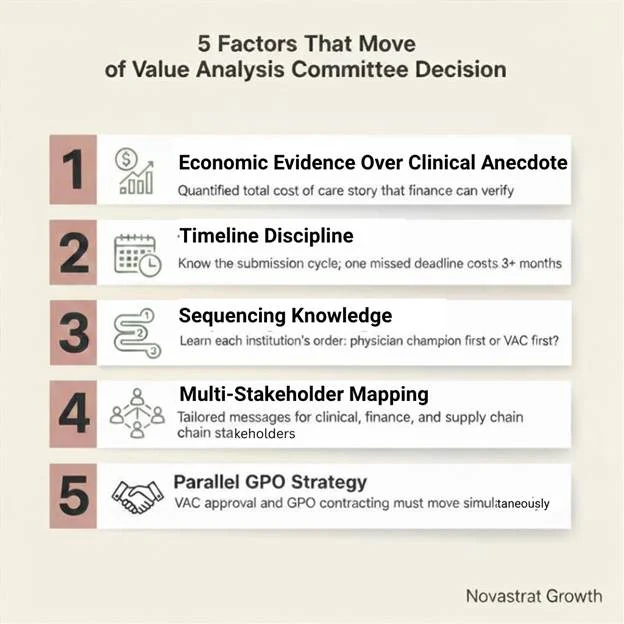
Pulling the research together, five factors consistently separate manufacturers who move VAC decisions from those who stall inside them.
1. Documented economic evidence beats clinical anecdote
Every time a finance or supply chain stakeholder is in the room, which is always, a device needs a quantified total cost of care story, not just a clinical outcomes story. The committee members without clinical backgrounds are structurally unable to evaluate a purely clinical argument. They will default to whoever has brought them numbers they can verify against their own institution's data.
2. Timeline discipline determines opportunity frequency
Given that many VACs meet monthly and some only quarterly, understanding a specific institution's submission cycle and meeting cadence before engaging is not a courtesy. It is the difference between a three-month process and a twelve-month one caused entirely by missing a single internal deadline.
3. Sequencing knowledge varies by institution
Does a given institution require physician champion buy-in before VAC submission, or does it require VAC approval before budget allocation? That question changes the entire go-to-market motion for that account. It needs to be learned account by account rather than assumed from a generic playbook.
4. Multi-stakeholder mapping matters more than relationship depth
Given that VACs and complex B2B buying groups broadly now run 6 to 13 members, each doing independent research before convening, a manufacturer needs a distinct, tailored message for the clinical stakeholder, the finance stakeholder, and the supply chain stakeholder. Not one message delivered to whichever of them happens to answer the phone.
5. GPO awareness must run parallel to VAC strategy
Because GPO contracts already touch the majority of non-labor hospital spend, and because institution-level value analysis approval is often required even when a national GPO agreement exists, manufacturers need both tracks moving simultaneously. Treating GPO contracting as a formality to handle after VAC approval clears is a common and expensive mistake.
The Honest Difficulty This Creates
None of this is a criticism of any individual manufacturer's sales team. It is a description of how genuinely complex the modern hospital buying environment has become.
A growing medtech company without dedicated HEOR capability, account-based commercial infrastructure, and institution-by-institution intelligence is operating at a structural disadvantage against larger competitors who built these capabilities years ago.
This is exactly the kind of go-to-market complexity that separates companies with strong clinical products from companies that convert those products into adopted, reimbursed, standard-of-care technology inside health systems.
The Question Worth Asking
If your VAC win rate feels unpredictable, or if approvals seem to depend heavily on which specific reviewer happens to be paying attention that quarter, the fix is not a better slide deck for your next clinical champion meeting.
It is building the economic evidence, the timeline intelligence, and the stakeholder-specific messaging that lets a device win on its actual merits, in front of the full range of people in that room, not just the one person who was already inclined to say yes.
Frequently Asked Questions
What is a Value Analysis Committee in healthcare?
A Value Analysis Committee is a multidisciplinary group inside a hospital or health system that evaluates whether a medical device, technology, or service should be approved for clinical use. The VAC is separate from the purchasing department; it decides if a product qualifies for use at all, while purchasing negotiates terms and executes the buy.
Who sits on a hospital Value Analysis Committee?
Typical VAC membership includes physicians, nurses, purchasing agents, finance representatives, infection control staff, and sometimes legal or risk management. Each member brings a different lens to the evaluation: clinical efficacy, cost, workflow impact, safety, and regulatory compliance.
How long does VAC approval take for medical devices?
VAC approval timelines vary widely. In many organizations, the process takes three to six months. In others, it can stretch toward a full year. Delays often result from structural factors like monthly or quarterly meeting schedules rather than issues with the product itself.
Why do medical device companies struggle with VAC approvals?
Most companies underestimate three things: the timeline, the number of stakeholders involved, and the shift from clinical evidence to economic proof. A sales approach built around one physician champion often fails because that champion is one voice in a committee of six to thirteen members with different priorities.
What evidence does a VAC need to approve a medical device?
VACs increasingly require health economics and outcomes research (HEOR) in addition to clinical data. They want quantified answers to questions like: Does this reduce total cost of care? Does it shorten length of stay? Does it change downstream resource utilization in ways the hospital's finance team can verify?
How do GPO contracts affect VAC decisions?
Group purchasing organization contracts cover the majority of non-labor hospital spend, but a national GPO agreement does not guarantee adoption at individual institutions. Manufacturers often need separate VAC approval at each hospital or IDN, even when a GPO contract exists.
Novastrat Growth works with healthcare and health tech companies navigating complex commercial environments, including hospital value analysis and health system adoption. If your VAC strategy needs a system behind it, contact Novastrat Growth
to discuss what that looks like for your specific situation.