


Why making your value understandable is a leadership responsibility
By Erika Rosenthal | Novastrat Growth | 9 minute read
Your offering may be valuable, yet prospects still struggle to understand what it will do for their business. When they have to translate your capabilities into their own business case, opportunities can stall before a meaningful sales conversation begins.
This article examines the work we unintentionally leave to buyers and how Voice of Customer research helps us make value clearer. Drawing on practical examples, you’ll learn how to:
- Recognize where your messaging asks buyers to connect the dots.
- Use customer interviews to uncover questions and expectations that marketing needs to address.
- Apply Pain > Claim > Gain to explain your value, substantiate it, and clarify what achieving it requires.
The leadership question is how much unnecessary effort our communication creates before someone can make a confident decision.
The expertise that makes value harder to explain
I have worked with accomplished engineers, scientists, and business leaders who understand their offerings at extraordinary depth. That expertise is an asset. It can also make it difficult to recognize what a prospective customer does not yet understand.
The team sees how the pieces fit together. It knows why a capability matters, what it replaces, and what becomes possible because of it. An explanation can therefore begin several steps ahead of the customer, or include so much detail that the business relevance gets buried.
An AI-enabled solution, for example, might describe its automation, integrations, and technical approach. A business owner may be trying to determine whether it can help attract qualified customers without adding another system to manage. The features may support that outcome, but the buyer should not have to discover the connection unaided.
Poor response to outreach does not, by itself, prove a messaging problem. Audience selection, deliverability, channel, and timing also matter. But when we have not established why the offering is relevant, sending the same explanation more frequently leaves the underlying work with the buyer.
A menu of services leaves the story unfinished
Consider a professional-services website that lists strategy, demand generation, marketing analytics, and campaign execution. Every service may be valuable. The list still asks a business owner to know what each term means and how it could improve the business.
Each service should connect to a business problem the buyer recognizes:
- Demand generation: We need more qualified opportunities.
- Marketing analytics: We need to know where to invest and where to stop spending.
- Marketing strategy: We need to decide which customers to pursue and how to compete.
A useful explanation begins with a recognizable situation: prospects arrive with little understanding of the offering; acquisition costs are difficult to justify; leadership cannot tell which marketing investments contribute to results. It then explains the approach, supplies relevant evidence, and makes the potential improvement tangible.
The service list can remain as supporting detail. The opening story should help a prospective customer understand whether the company can address a problem that matters to them.
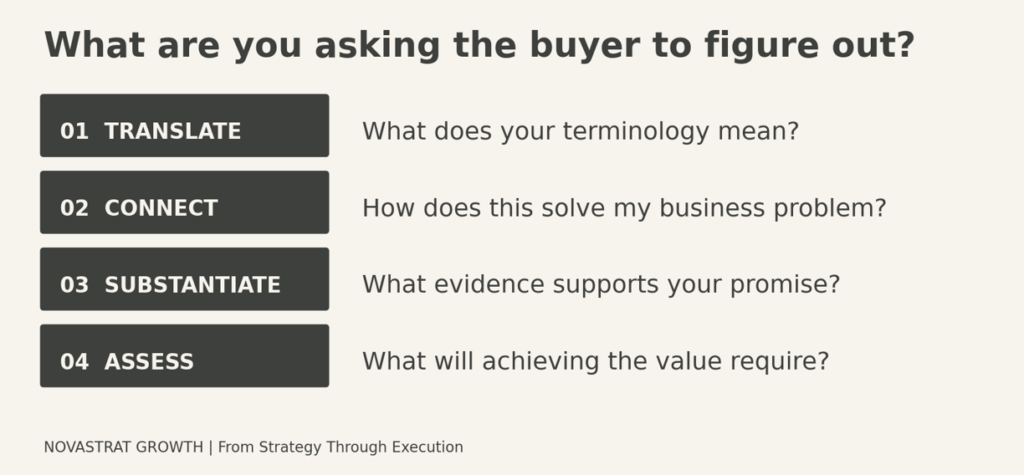
Figure 1. A conceptual framework for reviewing buyer effort, not a measured scoring model.
Where buyer effort becomes Decision Friction™
In my earlier article, The Hidden Cost of Complex Medical Device Messaging, I defined Decision Friction as the cumulative resistance that prevents stakeholders from confidently moving a decision forward. The principle extends to software, professional services, manufacturing, and other complex purchases.
The work of understanding value is one source of Decision Friction. The gap can appear at different points:
- Understanding: The buyer knows the words but cannot explain the business benefit to a colleague.
- Confidence: The benefit is attractive, but the evidence is insufficient to justify an investment.
- Commitment: The outcome is desirable, but the effort required to achieve it remains unclear.
A shorter message can help, but length is only part of the issue. The more useful test is whether the communication answers the questions necessary for the next decision. A concise list of unexplained capabilities can leave more work than a longer, well-organized explanation.
Voice of Customer reveals the missing connections
Voice of Customer work is especially useful because it tests our understanding against the customer’s experience. I want to know what prompted the purchase, what the customer expected, what they valued, and where the experience differed from their assumptions.
In one provider business, the offering helped practices develop an additional source of revenue through cash-based services. Leadership understood the appeal of that opportunity. Customer interviews revealed that some buyers interpreted the offering as having much of the business-building work handled for them.
They expected prospective patients to arrive ready to act. In practice, the providers also needed to:
- Explain the service and communicate its value.
- Discuss out-of-pocket costs.
- Convert inquiries into customers.
Those responsibilities represented a meaningful change from the way many had previously operated.
The revenue opportunity was real, but the conditions for realizing it were insufficiently understood. Customers were discovering the required commitment after joining. Some also questioned the continuing value of membership once they had acquired the initial knowledge.
The research uncovered multiple issues. Its value was helping us prioritize where to start:
- Set clearer expectations before purchase, including the provider’s required commitment.
- Improve inquiry quality, rather than focus primarily on lead volume.
- Strengthen training and support for conversion.
- Build continuing value and incentives for customers to remain engaged.
I used those findings to develop a marketing strategy that aligned communication with the experience the company needed to deliver.
As the company addressed the gaps between its promise and delivery, its brand reputation improved. Sales and new accounts increased, referrals increased, and churn declined. The progress came from addressing communication and delivery together.
The lesson is that making value understandable includes explaining what customers can expect, what they must contribute, and why the relationship remains valuable over time. Communication and delivery have to support the same promise.
Ask what customers understood before they bought
Three questions are particularly useful for exposing the gap between what we intend to communicate and what customers understand:
- What were your expectations when you joined?
- What do you know now that you wish you had known before?
- What questions did you need answered before signing the contract?
Ask current and former customers. Their experiences can reveal different gaps. Follow up on how expectations formed: a sales conversation, website language, a referral, or assumptions based on another business model. An expectation can exist even when the company never explicitly promised it.
The contract question identifies barriers marketing should anticipate and address before each prospect needs a sales conversation. Use the answers to improve website content, proof points, case studies, and explanations of implementation or customer responsibilities. Sales can then address the specifics of that buyer’s situation.
- Which question was hardest to get answered?
- Where did you find the answer?
- Did an unanswered question delay your decision?
Listen for repeated language and concrete experiences. A small set of interviews can uncover important patterns and generate hypotheses, but it does not establish how common each view is across the entire market. Use the findings to guide further investigation and to test the message with the intended audience.
Use Pain, Claim, Gain to organize the message
Once we understand the buyer’s situation, I use Pain > Claim > Gain, drawn from Patrick Renvoisé and Christophe Morin’s SalesBrain framework, presented in Neuromarketing: Understanding the Buy Buttons in Your Customer’s Brain and developed further in The Persuasion Code. The structure helps organize the problem, differentiated claims, and evidence of customer value. The application here also emphasizes realistic expectations about achieving that value.
Pain is the problem the customer recognizes and its consequence for the business. Avoid manufacturing anxiety or assuming every prospect has the same problem. The opening should help the right buyer recognize their own situation.
Claim explains what you can help change and why your approach deserves consideration. Support it with relevant evidence: an approved customer example, a demonstrated result, or a clear explanation of how the work produces value. Broad statements such as “more efficient” need substantiation.
Gain makes the resulting improvement concrete and substantiates its value through customer evidence, demonstrations, or relevant results. In applying the framework, I also make material conditions visible. If success requires implementation effort, customer participation, or a change in behavior, that belongs in the explanation before the buyer commits.
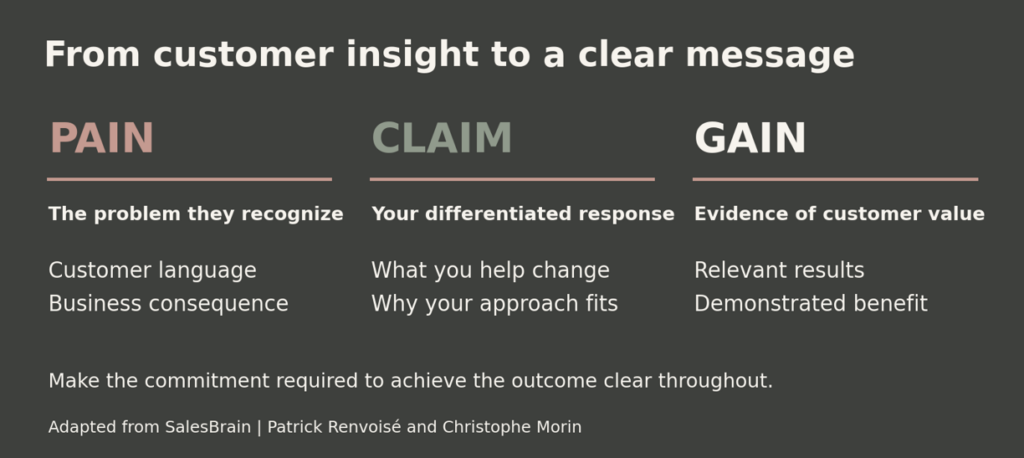
Figure 2. Adapted from SalesBrain’s framework by Patrick Renvoisé and Christophe Morin. VOC supplies the customer understanding.
For a hypothetical marketing engagement, the pain might be a pipeline filled with inquiries that rarely become credible opportunities. The claim would explain how customer research, targeting, and messaging help improve qualification, supported by evidence the firm can substantiate. The gain would be a more useful pipeline and less time spent on poor-fit conversations. Any claim about lower acquisition costs would require its own support.
Review your message from the buyer’s side
Choose one important website page, outreach email, or sales presentation. Ask someone who resembles your intended customer to review it and explain the offering back to you. Avoid coaching them through the answer; the gaps are useful evidence.
| Buyer question | What your message should make clear |
| What problem does this solve for me? | A recognizable situation and its business consequence |
| What will change? | A concrete benefit connected to the offering |
| Why should I believe it? | Relevant, credible evidence for the claim |
| What will it take? | Customer responsibilities, investment, and material conditions |
| What should I do next? | An appropriate next step with a clear purpose |
Then compare what the reviewer understood with what you intended. If they can repeat your features but cannot explain the business value, the message is leaving translation work unfinished. If they understand the outcome but have the wrong expectations about their role, the promise needs greater clarity.
Use those findings to decide what to rewrite, what evidence to add, and what the offering itself needs to deliver more consistently. Some gaps require a communication change. Others require an operational change before the message can credibly improve.
The cost of leaving the buyer to connect the dots
When the work of understanding value stays with the buyer, the consequences can extend across acquisition and retention:
- Qualified prospects move on before they understand the relevance of your offering.
- Sales teams repeatedly explain what marketing could have made clear.
- Unanswered questions delay decisions.
- Customers join with expectations that later contribute to dissatisfaction and churn.
Leadership may keep investing in more traffic, outreach, and sales activity while the same unanswered questions continue to limit results. Before adding more activity, examine what the buyer still has to figure out.
Start with one important page or presentation. Ask a target buyer to explain the value, the evidence, and the required commitment back to you. Their unanswered questions tell you where to begin.
If your offering is valuable but prospects struggle to understand why it matters, Novastrat Growth can help uncover the gap through VOC and translate the findings into positioning, messaging, and practical commercial tools. Contact erika@novastratgrowth.com.
Related reading: The Hidden Cost of Complex Medical Device Messaging
https://novastratgrowth.com/the-hidden-cost-of-complex-medical-device-messaging/
Framework attribution: Patrick Renvoisé and Christophe Morin, Neuromarketing: Understanding the Buy Buttons in Your Customer’s Brain; Christophe Morin and Patrick Renvoisé, The Persuasion Code: How Neuromarketing Can Help You Persuade Anyone, Anywhere, Anytime. See https://www.salesbrain.com/books